
If one googles “unconditional surrender” now, the first hits are all links to a boardgame. “Unconditional surrender” is not a game.
In January 1943 Franklin Delano Roosevelt announced the policy at the Casablanca Conference. The fear was that Joseph Stalin would negotiate a separate peace with Hitler if he didn’t feel that the United States and Britain were sufficiently committed to the war.1
FDR apparently surprised his audience by announcing a policy of unconditional surrender to signal their commitment to Stalin. He recalled the precedent of Ulysses S. Grant’s demand for unconditional surrender during the Civil War.2 3 So, FDR committed to the absolute eradication of the governments of Nazi Germany and Imperial Japan because those governments had no incentive whatsoever to come to terms since no terms were available.
The reaction to the policy was apparently considerable dismay by the British and American commanders, who were sure that it would ensure that the Axis powers fought to the death. For the men being drafted for the duration, it meant a longer and even more bitter war. Unconditional surrender led from strategic bombing to the 1,000 bomber raids over German cities, the fire-bombing of Dresden, and making the bricks bounce even in relatively minor cities like Heilbronn. The result wasn’t surrender. The result wasn’t reform of evil policies. If anything, the Holocaust accelerated. The result was bitter defiance from soldiers, citizens, and leaders.
The leader of the SS unit that penetrated American lines the furthest in Operation Nordwind, the branch of the Battle of the Bulge that engulfed my father’s unit, said that they had passed through Germany, saw the absolute destruction, learned of the dead friends and relatives, and were determined to make the Americans pay. Writing long after the war, he clearly felt no differently.
The result in Heilbronn, where ten thousand died in a single night raid and the rubble from the raid altered the course of the Neckar River altered the channel and reeked of the dead,4 was a murderous street battle in April 1945. My father’s unit spent days against intense resistance just a month from the final collapse, but ordinary Germans had been made bitter enemies. It’s argued that it stifled the German resistance.5
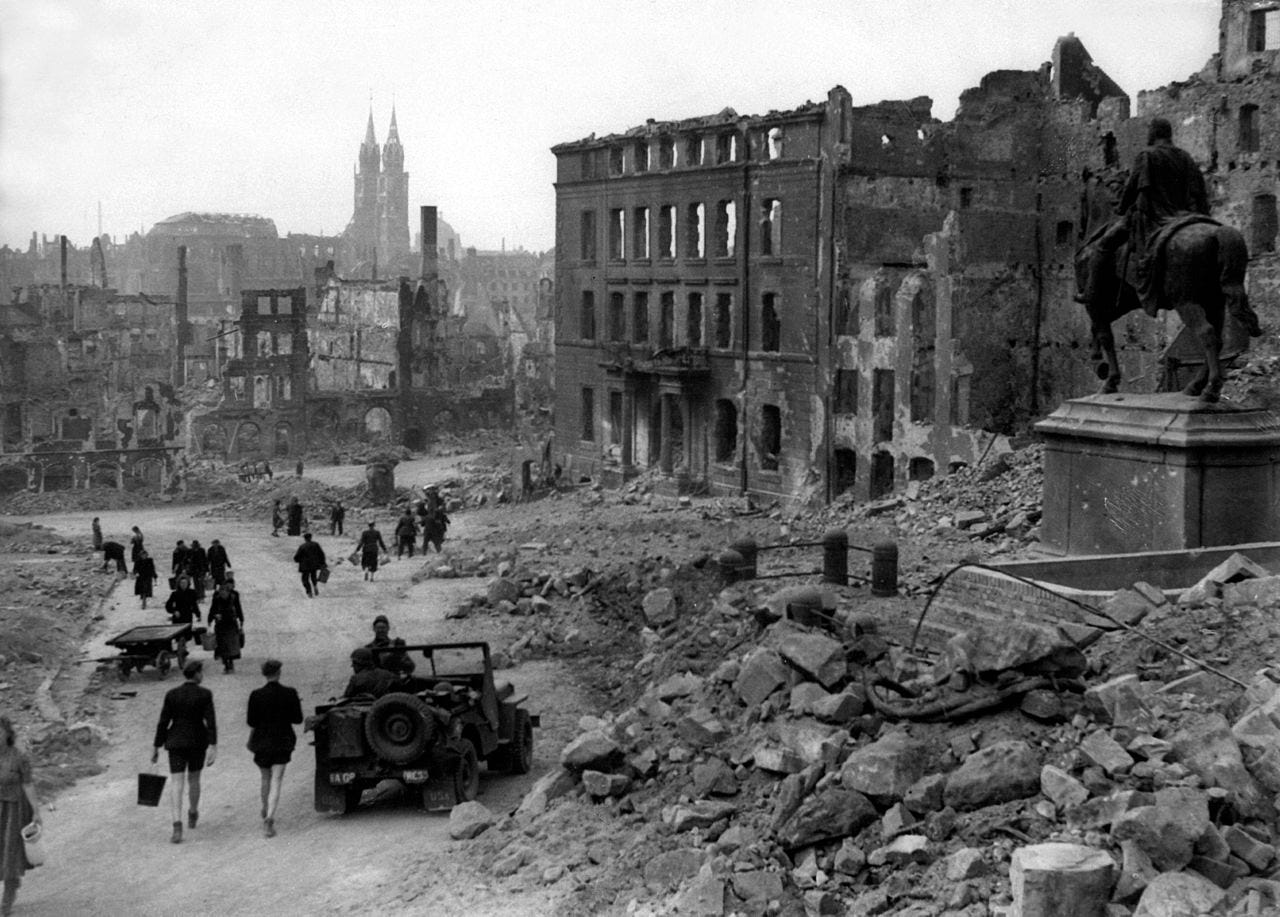
Bombing stiffened the resolve of citizens to resist, which the Allies might have realized from the experience in Britain. Unconditional surrender required ground forces, British, Canadian, and American men on the West and Soviets on the east, to battle for every square foot of territory. It ended only when the armies met at the Elbe River. There is an argument that the declaration of unconditional surrender, perhaps on the spur of the moment, also led to dire unintended consequences.6
The other consequence of unconditional surrender that my father experience was the occupation of a country where there was no government and no government services. There was no functioning currency, no post office, no Department of Transportation to repair infrastructure. The black market was unregulated and the only economy for many. That meant the army, which had just spent a year or more killing Germans, was the only government. My father used to laugh that, in his late twenties, as the captain of Company C of the 325th Combat Engineers, he was suddenly the mayor of the town they were in when they were told to stop hostilities. He had had no training at all. He hoped he did a good job. Unfortunately, many saw it as an opportunity to exploit the situation. By the time Dad arrived back in the States eight months after VE Day, he did not have a high opinion of human nature.
“Unconditional surrender” was not a game.
transcript was made by Warrant Officer Francis Terry. It is printed, with slight variations, in The Public Papers and Addresses of Franklin D. Roosevelt: 1943, The Tide Turns (New York: Harper & Brothers Publishers, 1950), pp. 37–45. https://history.state.gov/historicaldocuments/frus1941-43/d395
How U. S. Grant developed the strategy. https://www.battlefields.org/learn/articles/ulysses-s-grant-myth-unconditional-surrender-begins-fort-donelson
On a battlefield tour, one of the men in my father’s unit turned to me, suddenly hit with the memory of the smell of death as the 100th Infantry Division approached the Neckar River at Heilbrunn.
https://codoh.com/library/document/the-unfortunate-allied-demand-of-germanys-uncondit/
Bibliography
https://www.ebsco.com/research-starters/military-history-and-science/unconditional-surrender-policy
Armstrong, Anne. Unconditional Surrender: The Impact of the Casablanca Policy upon World War II. New Brunswick, N.J.: Rutgers University Press, 1961.
Black, Conrad. Franklin Delano Roosevelt: Champion of Freedom. New York: PublicAffairs Books, 2003.
In January 1943 "The Soviets on the Eastern Front were the only troops on the ground against Germany" in _Europe_.
British and then American troops had been fighting Germans and Italians in North Africa since June 1940. By the start of 1943 that campaign was becoming successful and in May it climaxed in the surrender of 250,000 Axis soldiers with all their equipment. For the North Africa campaign as a whole the Allies had suffered nearly 300,000 casualties while defeating multiple large Axis armies and capturing around 400,000 German and Italian troops.
Stalin at Casablanca waved off the above as a sideshow, and certainly the Soviets by that time had had a lot _more_ experience fighting Germans. Churchill understandably had a somewhat different view of things though.