
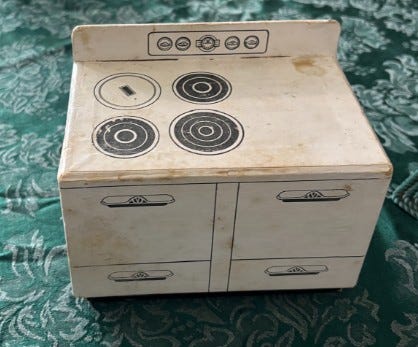
I have three recipe boxes my mother brought with her when she moved in with me at the end of her life. I just now decided to sort them out. One lovely wooden one is, I think, the recipe box from my Great Aunt Margaret. Mom, her niece, was her executor and a lot of things came from that estate. Aunt Margaret kindly wrote the name of the person who gave her the recipe on the card. It’s hard to realize now that people didn’t have much in the way of cookbooks. People relied on friends and relatives to give them something new to make. Margaret, my grandmother, and their two sisters had to use the recipes they shared with caution though. My mom told me that her mother and her sisters would deliberately leave out an ingredient so the sister’s dish was never quite as good as theirs.
Grandma’s box primarily contains cards with lists of ingredients for things she didn’t make all the time—cookies, cake, or pickles. There are few comments on method. The round of meat and potato and home canned vegetables and fruits didn’t vary. You ate what you had. So it was only the rare treats that got recorded.
The third box, however, took me longer to figure out because its original collection had gotten refiled and sorted into the others. When I got the cards assembled, I found the card that explained that these were Victory Recipes put out by Mrs. Emily W. Leister, home economics director, Toledo, Ohio.
A quick look through newspapers revealed that the boxes and recipes were sold in department stores in 1943.
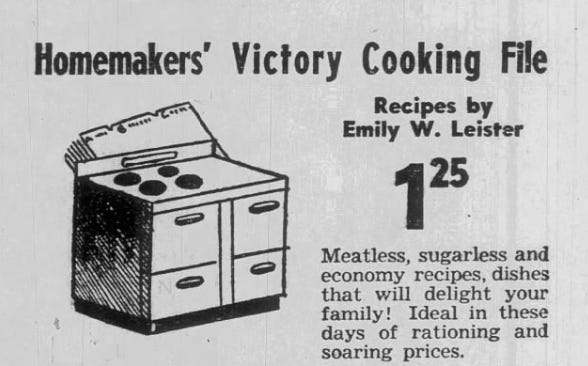
The top pulled off to reveal the recipes within. I suspect that Grandma and Aunt Margaret’s sister had bought them in the department store in Oneonta, New York, and had given them out. The cards were untouched. I think if they’d bought them themselves, they would have at least tried and stained a few. In 1943, Mom and her parents still lived on the farm. They still had chickens and butchered a hog yearly. They made their own maple syrup and maple sugar. They didn’t have to confront the mysteries of rationing with quite the same intensity as folks in town. And in the universe of Victory rationing advice, Mrs. Leister wasn’t as helpful as the newspapers.
Weirdly, the ad for the Victory File inspired Walker’s Department Store in Long Beach, California, to advertise it and rationing as a lovely return to the kitchen.
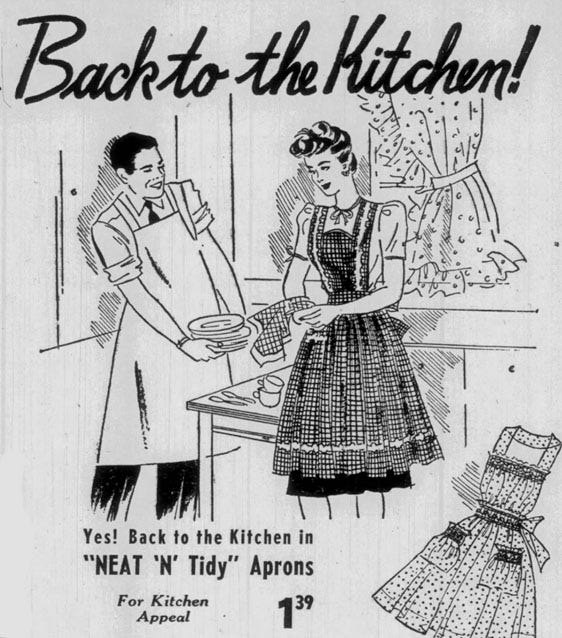
They might just be referring to the man bringing dishes in from the dining table. But men were not back in the kitchen. They had been drafted, or the couple was working separate factory shifts of long hours, trying to handle childcare. It wasn’t fun. Time was scarce and there were no frozen foods, no prepared food, no fast food, or takeout in most towns, and the things that were fast and familiar to cook weren’t available.
Rationing was a chaotic, ever-changing obstacle course to getting food on the table. Women (mostly) would stand in line, waiting to get to the grocery clerk only to find nothing was available even if they had the ration stamps. At the time, there weren’t self-service supermarkets. Grocers waited on customers, so only the grocers could tear out the valid stamps. Ration stamps were a license to buy, but there was guarantee the item would be available.
There were artificial shortages from panic buying, distribution problems because of gas and rubber shortages, rationing rules that changed by the week, and ever more inflationary pressures because of more money and fewer things to buy in the system. There were problems with shipping space (and German U-boats sinking what shipping space there was) and the military got first priority. Some things had uses other than food, but even food went first to the military, which was trying to supply every man with 4,000 calories a day, far more than most children of the Depression had ever seen.
It made sense that the Victory Recipe box was sold in 1943. It had taken most of a year since the spring of 1942 to get a full food rationing system into place.
Every man, woman, and child in the United States got issued ration books—about 130,000,000 ration books in every round. They relied on “volunteers” to run the system, and what did every town have? Teachers. So mom who was teaching during the war was the unpaid front line of rationing. Mom told me she sincerely disliked it all. Dealing with the buying habits of her neighbors, listening to their complaints, and trying to explain the complexities were no fun.
Ration Book Four was the most complicated. It had the red stamps (with a cornucopia on them) for meat and butter, it had blue stamps (with wheat) to be used for canned goods, it had black stamps (labeled “spare” but identified week-by-week for particular uses as the need arose), and it had green stamps (with the liberty torch) that were to be used in combination with blue stamps in mysterious ways.
Mom was always a “by the book” person who did what she was asked to do. She didn’t have a lot of tolerance for those who cut corners and didn’t “share and play square.” And she wouldn’t have had much patience for all the people who were trying to beat the system because they felt the war was something “over there.”
On December 3, 1942, in the town where Mom taught, Sidney, New York, there was a coffee stampede just before rationing began, and so there was none to be had even with a ration stamp. Coffee beans could be used to make plastic for airplane fuselages,1 but the primary reason for the shortage was the lack of shipping space.2 Beginning in 1942 civilians over the age of 15 got one pound of coffee beans every five weeks, which, the government estimated, would equal one six-ounce cup of coffee per day per person. On November 28, 1942, everyone had to declare the amount of coffee they had on hand to get their ration books. The teachers tore out the stamps from people’s books if they had “excessive” supplies of coffee on hand.
Sugar came primarily from the Philippines, which, of course, were immediately cut off.3 There were sources in the Western Hemisphere, but even those still required shipping, and there wasn’t enough cargo space, even if ships could get through the German submarines that were devastating the Atlantic sea lanes. Sugar went to the military, for the soldiers but also for industrial alcohol that was used in gunpowder, torpedo fuel, and dynamite. Each person had enough stamps to purchase 12 ounces of sugar per week. Seems like a lot, but that was for any baking or preserving.
I have my grandparents’ last ration books—Ration Book 4. I was amazed that all of the coffee stamps were still in the book, then I found out that coffee rationing had stopped early. However, the ration book had already been printed, so the Office of Price Administration went ahead and distributed it. When people saw the coffee stamps still in the books, they panicked. They were sure that the government was going to reverse the ruling, and there was another run on coffee in stores.4
There were two kinds of rationing. Coffee and sugar were under “uniform coupon rationing.” Everyone’s coupon meant the same thing and allowed the person to buy the same amount. As shortages accumulated, another form of rationing appeared in 1943, “point rationing.”
This is where it got complicated. A coupon was good for points, the points that something “cost” could change every week, and the points could be used for any combination of items in each of the controlled groups—meats, fats, processed foods, canned fish, and canned milk. The rules were so complicated they filled a whole page in the newspapers every week explaining that week’s values. At one period in the war, a person was allowed less than two pounds of meat per week, less than a quarter pound of butter, two ounces of cheese, ten ounces of fats and oils—if those things were even in the stores.5
In the red leatherette ration book holder, my grandmother kept a newspaper clipping with the rules for the end of 1943. It was gibberish:
The first red and blue stamps to expire under the new system will be those which came into use December 1 and 3 respectively. They will not be valid after March 31. They include: Red Q5, R5, and S5; Blue-X5, Y5, Z5, A2 and B2.
The point system introduced in 1943 also covered commercial canned goods. The problem with canned goods was the shortage of metal—steel and tin. All civilian uses of any kind—from food cans to bridge repair--were allotted only 5% of the steel supply. The other 95% went to the war.6 In World War I, every man in the military needed 90 pounds of steel for all the equipment and weapons to support him. In World War II, every man in the military needed 4900 pounds.7
Food cans presented a further problem. They were lined with tin, and tin had come from the Dutch East Indies, now firmly under Japanese control. In addition, the large producers of canned goods had converted to war production. Campbells, for instance, had converted entirely to canning the notorious “C” field rations for the Army.
Solutions were tried, discarded, reissued, and abandoned. It made an ordinary person’s head spin. The law of unintended consequences ruled. Confronted with a severe paper shortage, the OPA issued an order that bakeries should no longer slice their bread in order to save the wax paper that the sliced loaves were wrapped in.8 However, most households did not have the kind of serrated bread knife needed to slice freshly baked bread without tearing it to shreds or crushing the loaf. With the wrong knife, homemakers ended up wasting scarce bread with slices that were too thick or crooked. So, homemakers went out looking for serrated bread knives, which, being made of steel, were not available. The expression “the greatest thing since sliced bread” may sound sardonic, but in 1943, sliced bread was a great thing.
The newspapers were full of recipes to use strange cuts of meat or substitutions for absent ingredients and new uses for old ingredients. Lessons on Victory Gardens and Victory Cooking were everywhere, even Chicago’s Museum of Science and Industry. Or you could buy Mrs. Leister’s recipe box. Every card had a photo of the dish to show how it could be presented to make it look appetizing.
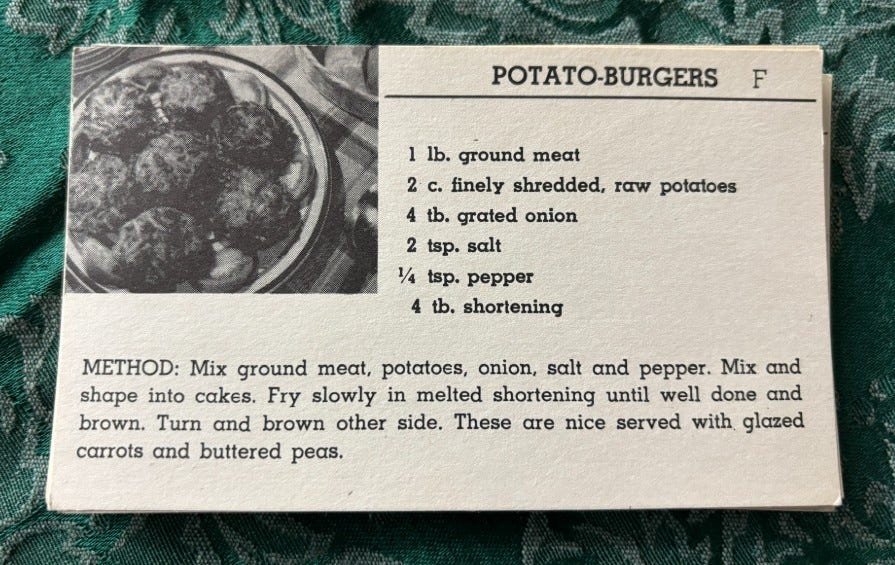
Meat of course was the great conundrum in a country that ate plain steak and potatoes when it could.
There’s a recipe for broiling a slice of bologna until it curls into a cup and then filling the cup with buttered canned peas. There was Chicken Walnut Casserole that fed 8 with just a cup of diced chicken. And Sandwich Towers where layers of brown and white bread cut in ever smaller circles were spread with peanut butter, cottage cheese, and jam. Or if that isn’t tempting, there’s Walnut Fluff with mashed potatoes, mashed carrots, 1 egg, ½ cup of grated cheese, and a cup of walnuts to serve 8. There are Potato Chocolate Brownies and Victory Walnut Cookies, which use figs and dates to make up for the sugar shortages.
In the end it was obvious that Mrs. Leister wasn’t much help to the Palmer sisters. The cards were untouched. But the last thing my mom would ever do is throw something out that might be useful. I think that coming of age in the Great Depression and starting out in life through years of war shortages caused my mother to internalize “use it up, wear it out, make it do, or do without” right down to her DNA. She couldn’t throw anything out that she might possibly find a use for. She did feel better once recycling came back in vogue, and she could return things to the material stream.
I’ve realized that this was a fundamental rupture between the War Generation and their Boomer children. Though we didn’t have a lot growing up, we had enough. She lived in a world where everything was scarce and expensive and events could turn on a dime against you. I lived in a world where we had enough and abundance was just around the corner.
Coda: At a used book sale, I found a cookbook with a Victory cooking section, so I might take a look at that next since I’m on the topic.
Richard Lingeman, Don’t You Know There’s a War On? the American Home Front 1941-1945. p. 125
The war spread the use of instant coffee. It was a recent invention of Nescafe, a Swiss firm with factories in France, England, and the United States. It solved the shipping problem, being so much more compact that whole coffee beans, but it was still rare stateside. All the instant in the United States was going into “C” rations, where it was introduced to millions of G.I.’s and the population of Europe.
Doris Weatherford, American Women and World War II, p. 200
Lingeman, p. 246
John Bush Jones, All-out for Vicltory! Magazine Advertising and the World War II Home Front, Brandeis University Press, Waltham Mass. 2009 p. 213
Weatherford, p. 204
Editor Karl Drew Hartzell, The Empire State at War. Report of the New York State War Council. p. 44
Sidney, New York, Enterprise 3/11/1943