
What's a Generation?
The origins of the idea that there are Generations in World War I
I’ve said to people that this is a history of World War II as it was experienced by ordinary people, using my parents as the narrative arc. In some ways it’s more the history of a generation that was swept into World War II and emerged out of the experience as changed people in a changed world.
If I’m writing about Capital G Generations, I thought I’d better pin down the concept. Obviously there have been begats since the Bible and family genealogy but no one thought to name a whole age cohort until the 20th century. And a family generation can be extremely long. My great grandfather Palmer was born in 1862. His oldest sibling was born in 1831. If a Generation implies some shared worldview shaped by events, they couldn’t have been farther apart. Two of his brothers fought in the Civil War.
Apparently the first articulation of the idea that an age cohort might over-ride family and other forms of social stratification to form “Generational Consciousness” was a German named Karl Mannheim in 1922. He thought formation of consciousness required exposure to a major historical event as they came of age. As a professor of mine used to say when drawing a correlation where he couldn’t prove causation, it’s no accident that he came up with this idea in 1922 after a generation had experienced World War I and the rapid technological and social changes that swept through afterward.
American sources tend to say that the first use of a generational label is Gertrude Stein telling Ernest Hemingway “You are all a lost generation.” This appears as the epigraph to Hemingway’s novel The Sun Also Rises. This is something I know something about. My PhD dissertation was about the memoirs of Americans in Paris in the 1920s.
At the time, Hemingway wanted to be known as an artist playing in the Modernist big leagues. It was only later that he constructed an identity as Papa Hemingway and chased mainstream fame and endorsement deals. The underlying frame for the Sun Also Rises T.S. Eliot’s the Wasteland, with Jake Barnes as the wounded Fisher King. By opening the novel with Stein’s quote, he was establishing his Modernist bona fides. It was “in conversation” so it proved he hung out with the Modernist Sibyl in her Paris salon. She was yet to copy Hemingway and create a populat mainstream persona (so popular after The Autobiography of Alice B. Toklas that the Marx Brothers used her in a gag and knew the audience would recognize it). The reviewers though mostly found it pretentious to claim there was anything special about a bunch of expatriate drunks milling about Europe. The term did not catch on except in other book reviews.
Hemingway came up with variations of the origin, mostly involving an auto mechanic working on her Model T. The variation in A Moveable Feast was retribution for Stein making him look bad. A Moveable Feast was for settling scores, not recording reliable memories.
Stein herself recalled in Everybody’s Autobiography that
It was this hotel keeper who said what it is said I said that the war generation was a lost generation. And he said it in this way. He said that every man becomes civilized between the ages of eighteen and twenty-five. If he does not go through a civilizing experience at that time in his life he will not be a civilized man. And the men who went to the war at eighteen missed the period of civilizing, and they could never be civilized. They were a lost generation.
Of course, Stein wasn’t a reliable narrator either.
Hemingway didn’t intend that it would apply to car mechanics or bell hops. He wanted to celebrate the specially damned.
It took Malcolm Cowley and World War II to solidify the idea of a Lost Generation—but for him and everyone else, it’s a term that applies to a very narrow span of birth years and a very special group of writers. Born in the 1890s, they rushed overseas to experience the excitement of war, primarily as ambulance or munitions drivers for the French. After the war, they were indeed a uniquely influential group of writers also shaped by the Jazz Age.
Malcolm Cowley isn’t known now, but he was a man with tremendous power in the literary world after WWII. He was a poet, who earned a living as a pundit, until he became an editor at Viking Press. He transformed the later careers and reputations of his cohort of authors. He resurrected the vanishing reputations of Faulkner and Fitzgerald and even changed opinions about Hemingway1 as a serious author by publishing collections of their works and writing introductions. After Faulkner won the Nobel Prize in 1949, he said, "I owe Malcolm Cowley the kind of debt no man could ever repay."2
Before Cowley stamped the Lost Generation in the national consciousness in the 1950s, there were a few feeble attempts to apply it to the men fighting World War II, anticipating that they too would produce a flowering of literature. 3 That didn’t happen. With hindsight, in the 1970s Cowley pointed out the fallacy of labeling a generation too soon. He pointed out that the Lost Generation of writers were in fact the Lucky Generation. They launched careers in the flush decade of the Twenties, had an audience by the time the Depression hit, had a second flowering after World War II, and died in the 1960s just before everything changed.
Cowley tried to develop his sense of his own generation into a test for recognizing a literary generation, unconsciously (as far as I know) tapping into Mannheim’s broader definition. A cohort becomes a srongly self-aware generation when it has the following:
A shared sense of perceptions. It “plays the same games, hums the same tunes, wears the same sort of clothes, reads the same books.”4
A rupture with the past that shows as a rejection of its parents. “What distinguishes a real generation is its thoroughness and even violence in casting aside parental or merely prevailing notions.”5
Precursors and models “the madmen and outlaws” of an earlier cohort.6
Leaders and exemplars that set a distinctive lifestyle adopted by the group.7
A shared historic event “that will furnish its members with a common fund of experience.”
If it’s a clearly defined generation, the most important aspect is number 5, a crucible that sweeps a broad cohort into profound change.
It’s no accident that the most clearly delineated generations experienced war. However, the World War II generation, born between 1901 and 1927, didn’t call themselves much of anything. There was some use of the War Generation early on and a bit later the “G.I. Generation,” or “G.I. Joe Generation” but the use was limited. Then in 1998, Tom Brokaw published “The Greatest Generation.” That is the term that has stuck, but it’s of course the younger groups who were paying belated recognition. The generation itself was far more cynical or even disgusted. My mother utterly despised it. As she told me, “we just did what we had to do.”
I suspect the World War II generation didn’t need a label. They knew who they were in a way other people couldn’t understand. I’ve thought about what gave the men I grew up with, my father’s generation, such a different feel. Men dressed differently than boys or kids. They also had a centered inwardness, a gravitas, even when they made jokes. I think they all knew exactly who they were. They knew their dark sides, they knew how they did or didn’t rise to the occasion. And of course, they had bottled all of it up inside. They didn’t talk about it. And even if they weren’t among the men who saw combat, they had torn apart their early lives to find defense work.
Thinking about it, I recalled the campground in rural Florida where my parents spent the winters after they retired. The first wave of settlers were all of the same generation. There was an ease and understanding where they all met each other. My parents did not make friends easily but they had friends there. It didn’t strike me until that generation no longer came to the campground. A new wave of people showed up. They were nice enough but it wasn’t the same. They were the Silent Generation, more defined but what they weren’t—not the War Generation and not the Boomers—than what they were.
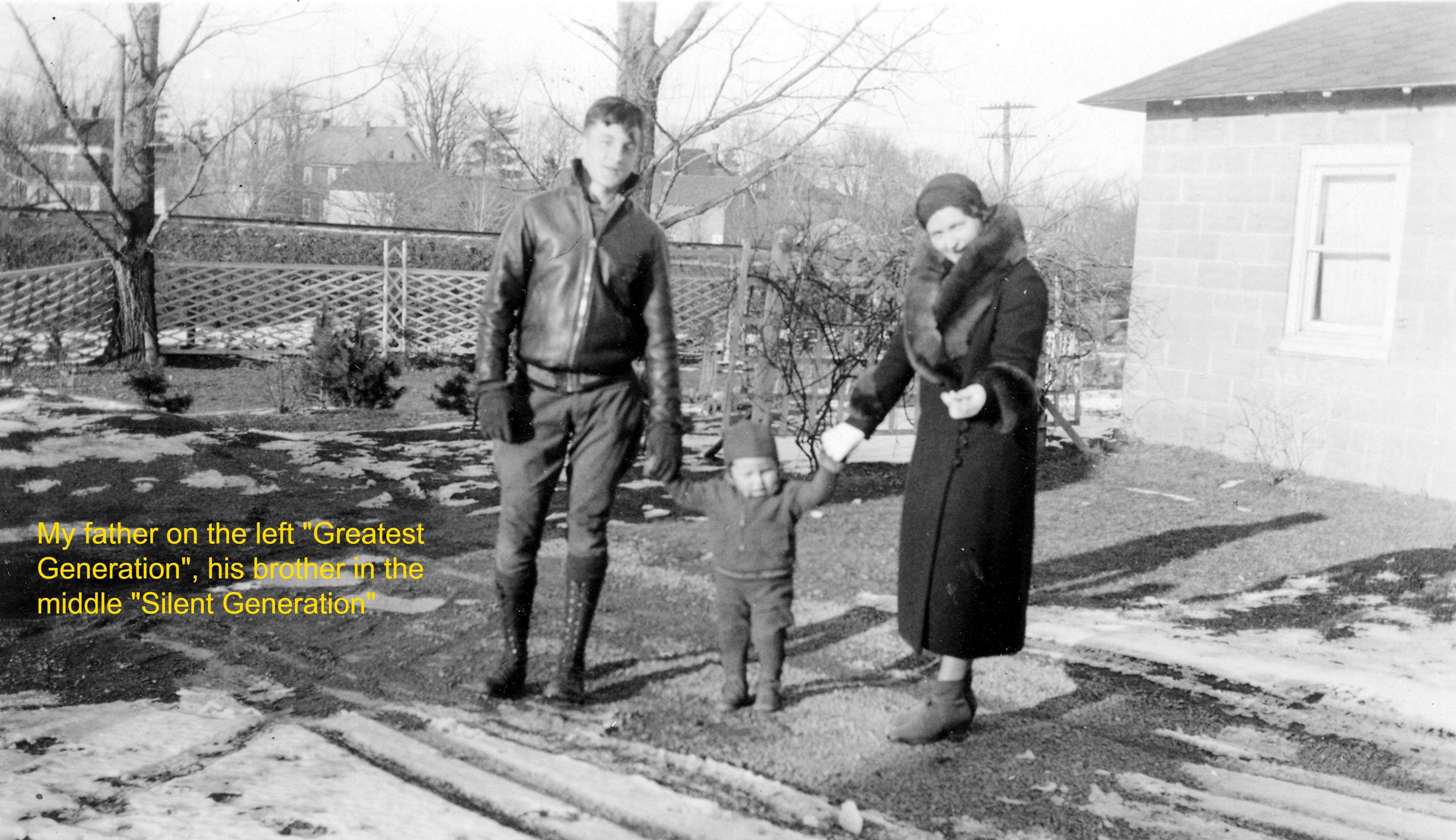
My father’s brother was born 14 years after him. At my father’s memorial, he remembered his kind caring big brother. I’m afraid his wife and daughters snorted. My mother told me that the man who came home from the war was unrecognizable. It was after the war that his group was clearly a generation, marked in their formative years. Dad tried to establish a relationship with his brother, the teenager. But in the end, there was no relationship. The rejection caused great pain to Dad, but his brother just had other things to do, a different world to live in.
Of course, then there was the offspring of the War Generation. The Boomers of course are hard to miss. Life magazine as early as 1941 noticed there were a lot of babies, a “baby boom.” As they aged into the 1960s, they hit all of Cowley’s criteria for generational consciousness, especially when the Vietnam War forged a deep division within the generation. And like the pretentious Lost Generation, Boomers could be annoying. I always remember Mom saying in exasperation to me, a Boomer, “oh it’s always Boomer this and Boomer that.” The Pew Opinion Research notes, the Boomers are the most well-defined generation in the 20th Century.8 But I would argue that the years they assign don’t have real meaning. People in 1964 might still be in the demographic of a boom in births but there is no way they share the ruptures that happened in the 1960s or even the cultural guideposts.
Then in 1991, along came two sociologists, Neil Howe and William Strauss, who decided everyone gets to be a generation in a book aptly called “Generations.” They wisely chose letters for the labels rather than descriptors since it’s not entirely clear what traits they have since some haven’t gotten out of kindergarten, let alone confronted historic events as they come of age.
Online people argue about what post-Boomer generation does what and what years should be where. At least they all have rejection of the Boomers in common. Generational consciousness seems a bit hazy, at least from outside. But if the price of strong generational consciousness is coming of age in war and radical social change, it’s perhaps a blessing to not live in interesting times.
Hemingway hated Cowley, calling him a potato-faced poet.
Krebs, Albin (May 29, 1989). “Malcolm Cowley, Writer, Is Dead at 90”. The New York Times. p. A1.
Cowley is most remembered now for his memoir of Paris in the 1920s, “Exile’s Return.” He first published it in 1934 as a diatribe against the selfish indulgence of the Twenties and a call to collective political action in the sobering dawn of the Depression. It sank like a stone. He resurrected the memoir in 1954. He edited out all of the criticism, all of the leftist commentary, and celebrated his generation of writers. After World War II, there was suddenly interest in the mythic Left Bank, where Gene Kelly danced with Leslie Caron. The memoir sold.
Cowley, And I Worked at the Writer’s Trade, 1978, p. 10.
Cowley, p. 11
Cowley p. 11
Cowley p. 12